
Property Marketing Is Changing. So We Started Building Our Own Tech.
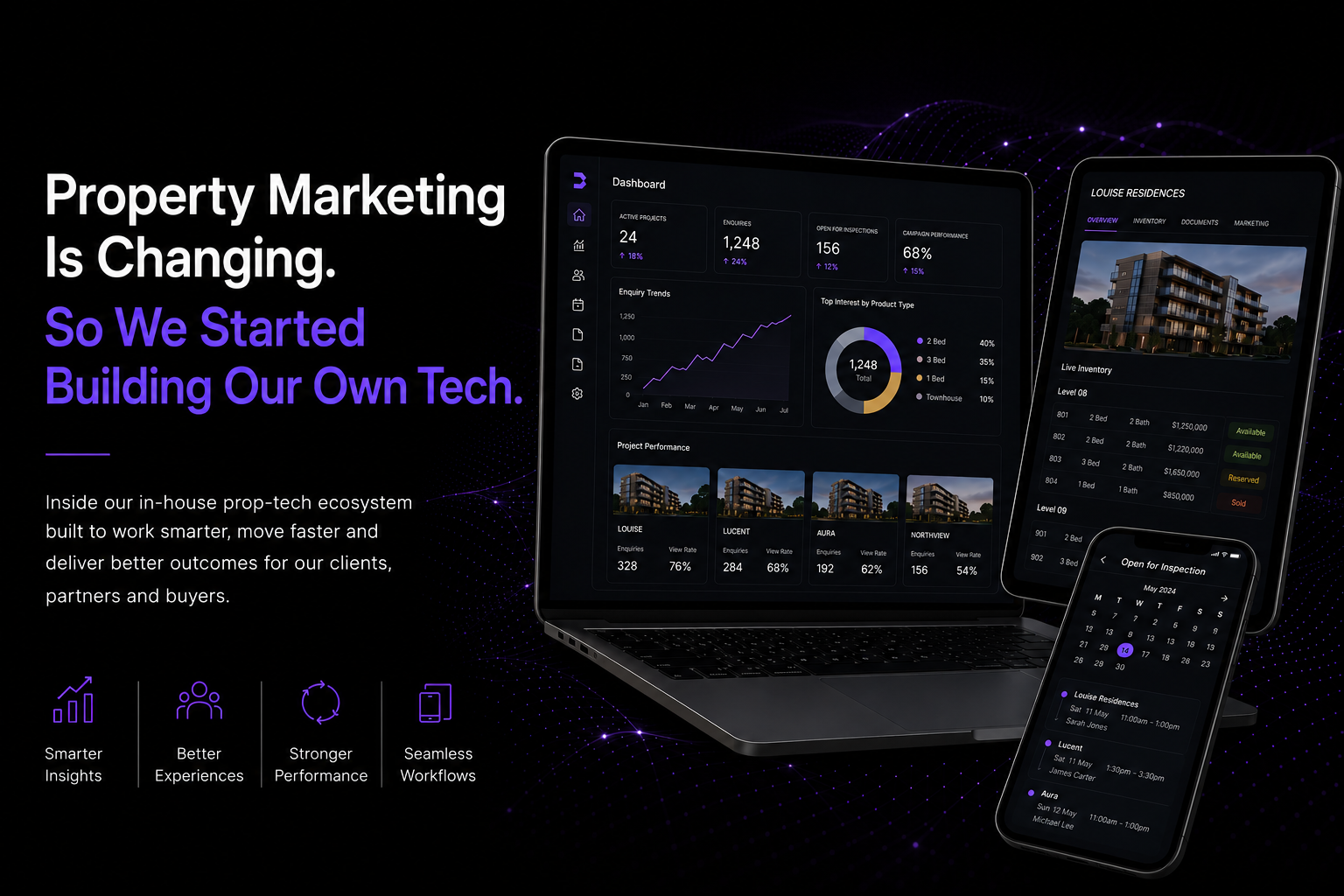
It’s been an interesting year from a technology point of view.
Particularly in project marketing and property.
What’s become increasingly clear to us is that while some of the world’s best software platforms are incredibly powerful, most businesses only actually use small parts of them.
That’s certainly been the case for us.
Like most companies, we’ve spent years working across dozens of different platforms. One for CRM. One for email marketing. One for scheduling. One for reporting. One for campaign approvals. One for analytics.
Individually, they’re all excellent.
But collectively, they often create friction.
Disconnected workflows. Duplicate data. Endless spreadsheets. Systems that don’t naturally speak to one another. Teams adapting themselves around software, instead of software adapting around the way teams actually work.
So over the past year, we started asking a different question:
What if we stopped forcing our workflow into generic platforms, and instead built technology specifically around the way project marketing actually operates?
That idea has led us much deeper into prop-tech and internal product development than we originally expected.
Not to replace best-in-class platforms.
But to rethink the gaps between them.
To build smarter systems around project marketing, developer reporting, buyer engagement and operational efficiency.
And ultimately, to create a more connected experience for everyone involved — developers, agents, channel partners and buyers.
Building Technology Around the Realities of Project Marketing
Project marketing is a uniquely layered business.
You’re managing campaigns, buyers, channel agents, pricing, availability, inspections, construction updates and developer reporting simultaneously — often across multiple projects at once.
Yet much of the industry still relies heavily on fragmented workflows.
Spreadsheets. PDFs. Email chains. Static reports. Manual updates.
We felt there was an opportunity to rethink that.
Not from a theoretical “tech startup” perspective, but from the perspective of a team living inside these processes every day.
That’s where many of our internal platforms started.
Buyer Concierge — Smarter Buyer Matching
Another platform we’ve been developing is Buyer Concierge.
An interactive tool designed to better connect buyers with projects that genuinely suit what they’re looking for.
Rather than pushing buyers through generic enquiry funnels, the platform allows users to answer a series of simple questions around budget, location, bedroom requirements, lifestyle preferences and timing.
From there, we can match them with relevant opportunities across our portfolio in a far more tailored and intuitive way.
For buyers, it creates a simpler and more personalised discovery experience.
For developers, it helps ensure enquiry is more aligned with the product itself.
In many ways, it’s about using technology to create better quality connections between people and property.
Campaign Brief — Rebuilding Campaign Workflow
Another area we felt needed improvement was campaign workflow.
Traditionally, creative approvals and campaign tracking in property can become fragmented quickly — spreadsheets, PDFs, email feedback, multiple versions of ads floating between teams.
So we built Campaign Brief.
An internal platform designed specifically around the way modern project marketing campaigns actually operate.
It allows our team and clients to:
View campaign creatives interactively
Review ads across different formats
Track iterations and revisions
Leave feedback directly within the platform
Manage approvals in one place
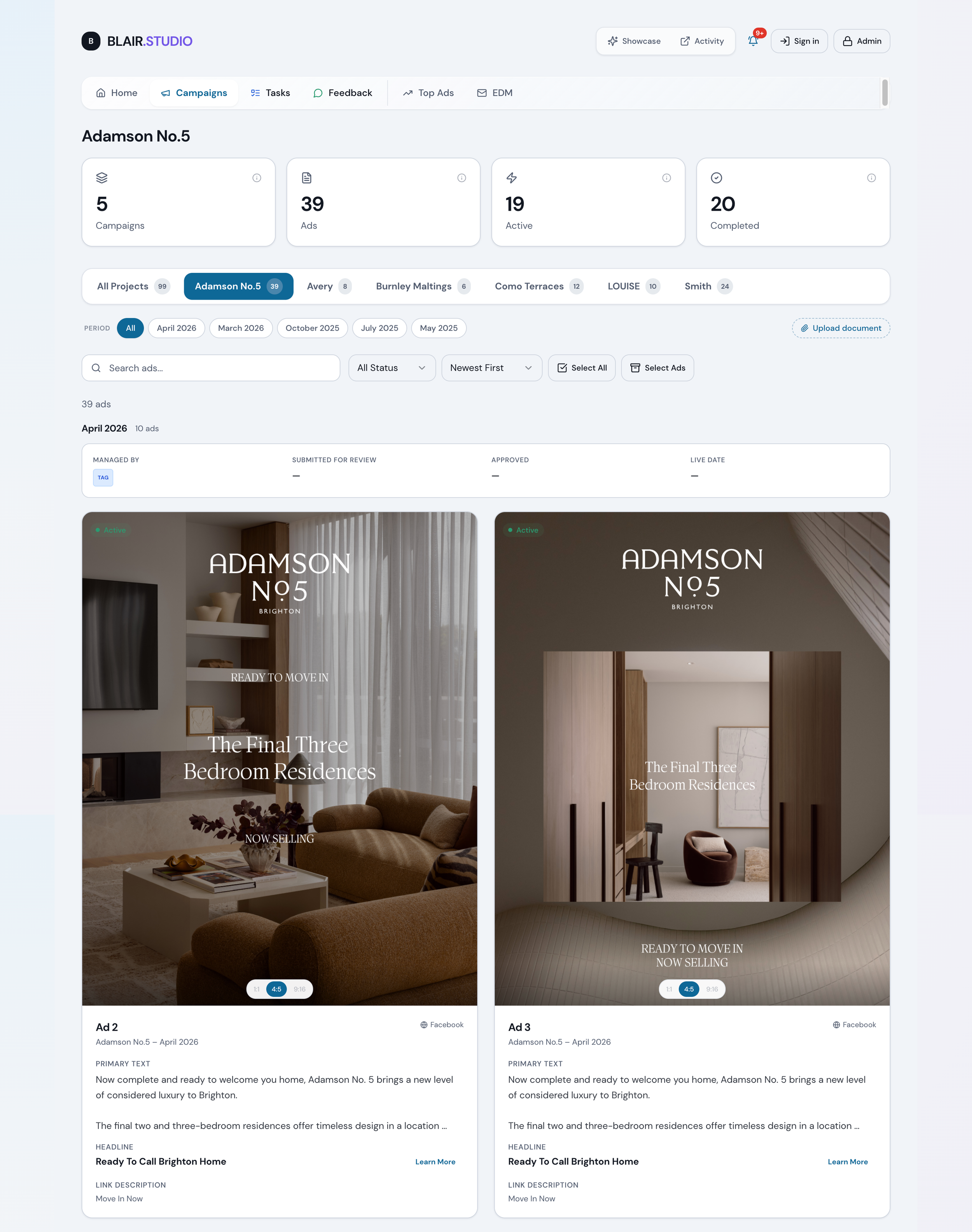
Blair Studio - Campaign Brief Tracking
Instead of static spreadsheets and long email chains, campaigns now live inside a far more visual, collaborative and intuitive environment.
It’s faster, cleaner and significantly more streamlined.
Particularly when managing multiple campaigns simultaneously across different developments.
Alongside this, we’ve also rebuilt parts of our operational workflow internally.
Our Open for Inspection platform integrates directly with our calendars and internal systems, allowing us to track inspections, attendance, staffing allocation, project activity and operational hours across the business in real time.
What sounds simple on paper becomes incredibly valuable when managing multiple active developments simultaneously.
Rethinking Developer Reporting
One of the more interesting shifts has been how we present campaign performance and marketing spend to developers.
Traditionally, this has often lived inside static spreadsheets and reports.
So we rebuilt that experience too.
Our internal marketing budget and spend dashboards allow developers to interact with campaign budgets dynamically, shifting allocations live and immediately understanding how changes impact the broader campaign strategy.
Instead of static reporting, it becomes an interactive planning and forecasting tool.
More transparent. More collaborative. More strategic.
A More Modern Buyer Experience
One of the most exciting areas we’re currently developing is buyer experience technology.
A platform called Settle is currently in progress — designed to centralise the entire construction update and settlement journey for purchasers.
Instead of fragmented emails and inconsistent updates, buyers will have a personalised login connected specifically to their residence and project.
From there, they’ll be able to:
Track construction progress
View timelines and milestones
Access project updates, photos and videos
Receive settlement information
Stay connected throughout the build journey
Importantly, the platform is designed to translate technical project updates into clear, consumer-friendly communication automatically.
The goal isn’t simply better reporting.
It’s reducing uncertainty, improving transparency and creating a more connected ownership experience throughout the build process.
StoryFlow — Property Marketing Built for Modern Attention Spans
We’ve also been experimenting with how projects are experienced digitally.
Today, most people consume content vertically, interactively and quickly — swiping through stories, reels and bite-sized content formats.
Yet much of property marketing still relies heavily on static brochures and traditional EDM structures.
StoryFlow was born from that disconnect.
It’s an interactive, story-style experience that allows buyers to move through a project in a far more intuitive and engaging way, while also helping developers understand which aspects of a project are resonating most strongly with audiences.
That insight allows projects to be communicated more clearly and effectively over time.
In many ways, it feels more aligned with modern digital behaviour.
Less static. More immersive.
Reimagining the “Link in Bio”
One of the more interesting projects we explored started with something surprisingly simple:
The Instagram link in bio.
Most existing platforms felt generic and transactional — essentially just a list of links.
But property is visual. Emotional. Experiential.
So we started building our own version from the ground up.
Not just a landing page, but a far more immersive digital entry point into our projects and brand.
The platform allows users to move through developments, videos, updates, editorial content and registrations in a much more intuitive and engaging way — closer to the experience of browsing a premium digital publication than clicking through a traditional link hub.
It’s designed around the way people actually consume content today:
Fast. Visual. Interactive. Mobile-first.
In many ways, it reflects a broader shift happening across property marketing.
Even the smallest digital touchpoints now shape how people perceive a project, experience a brand and engage with content.
And increasingly, those experiences matter just as much as the destination itself.
We’re Only Just Getting Started
What’s become increasingly obvious is that modern businesses no longer need to wait years or spend millions building technology.
Ideas can now be tested, refined and deployed rapidly.
That changes everything.
It allows businesses like ours to rethink longstanding industry workflows and build tools specifically around the needs of our clients, buyers and team.
Not generic software adapted to property.
But property technology built around the way the industry actually works.
And in many ways, we feel like we’re only scratching the surface.